

This standalone page focuses exclusively on LGBT emigration, with particular reference to London.
Emigration is a strong theme of Irish history, and that includes LGBT emigrants. Irish people emigrated for various reasons: to get a job and better social and economic opportunities; for the working class and rural landless labourers to escape the snobbery and restrictions of a closed, provincial society; and, probably, for all emigrants, to attain greater personal freedoms, released from the shackles of Church and State. As one gay man put it, he emigrated in the 1980s to achieve “the simple dignity of living openly and honestly.”
The resources here highlight stories linked to the impact of emigration on the Irish forced to do so, particularly to a major city like London.
Kieran would like to highlight EPIC’s “LGBTQ+ Emigration Stories: Then and Now”. This exhibition examines the changing relationship between LGBTQ+ identity and emigration, through personal stories spanning Ireland’s journey from exclusion to greater equality.
A resource list publication is downloadable here.

6 and 26 October 2026
Two articles:
(1) ‘A closure for us’: Cork family learns brother missing since 1992 died in UK two years ago’ [Irish Times article]
The Irish Times article tells the story of Patrick (Patsy) O’Sullivan, a Cork man who disappeared in 1992 after visiting his family and was never heard from again. More than 30 years later, his family learned that he had moved to the UK, changed his name to Patrick Aldridge in 1995, and died of sepsis in July 2024. His brother Jerry O’Sullivan believes Patsy may have chosen to start a new life because Ireland was far less accepting of gay people in the early 1990s.
(2) ‘It wasn’t a voluntary emigration’: Patsy O’Sullivan was part of a generation who fled Ireland’ [theJournal.ie]
This theJournal.ie article uses the story of Patrick “Patsy” O’Sullivan to explore a wider phenomenon: the emigration of many LGBTQ+ Irish people who felt forced to leave Ireland because of anti-gay laws and social hostility. The article argues that many gay people of Patsy’s generation did not emigrate by choice but to escape discrimination, stigma and the threat of prosecution. Kieran and Karl Hayden are quoted in this article.

30 May 2026
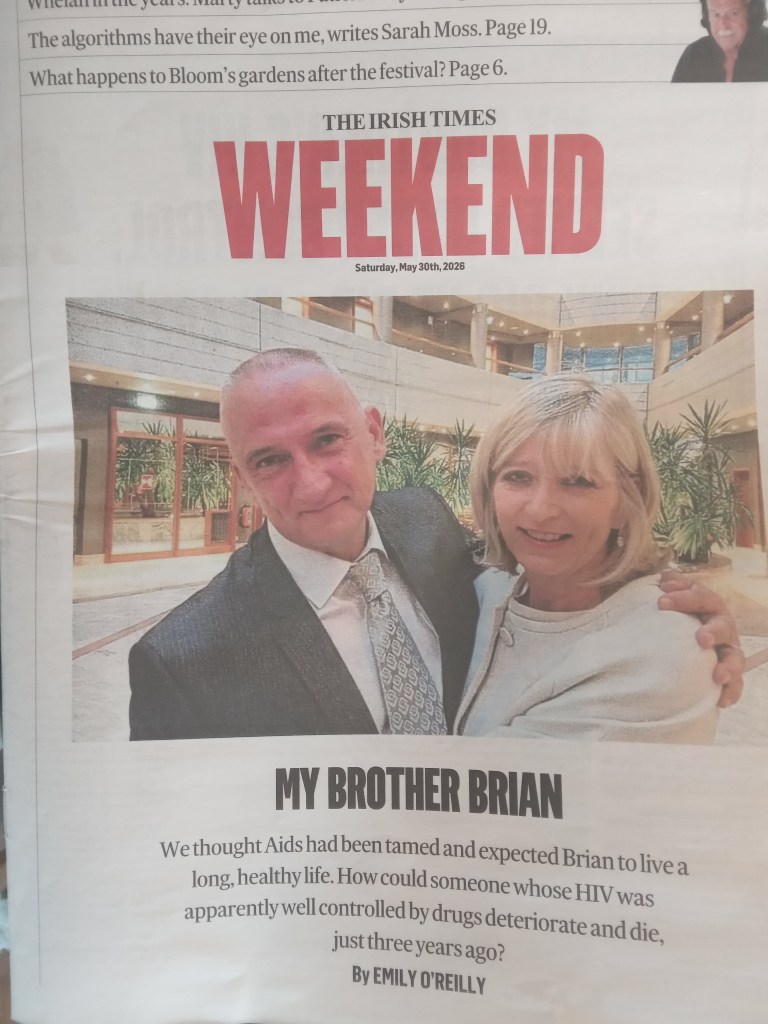
‘Emily O’Reilly: My brother’s HIV seemed under control. So why did he die?’ [Irish Times article]
Emily O’Reilly’s article, My Brother Brian, published in The Irish Times on 30 May 2026, explores the reasons behind her brother’s emigration from Ireland in the early 1980s.
Brian emigrated to New York in 1982 at the age of 21, leaving behind his family, his architectural studies, and an Ireland still deeply marked by homophobia. In 1990, he tested positive for HIV. He later moved to London, where he lived with his partner for the remainder of his life.
Brian died on 29 May 2023, aged 62, at London’s Whittington Hospital.
15 March 2026
‘For many, growing up queer in Ireland was a trauma almost – they ran away’ [Irish Times article]
This article profiles Derek Murphy, a Cork-born actor and producer in London, and explores how his work with Queer Irish Film & Television UK (Q-IFTUK) seeks to reconnect LGBTQ+ Irish people with their Irish identity while increasing visibility for queer Irish stories and experiences.

29 January 2026
‘Alban Currano tribute’ [Facebook post]
A moving, brief tribute to Alban (left) written by his friend Felix Craig (right) posted on The AIDS Memorial Facebook page.


29 May 2022
‘Dublin was no city for gay young men’ – the Father Ted star who thrived in London‘ [News Article]
An ultimately happy story about Father Ted actor and author Patrick Duggan. The 1980s and 1990s saw many escape a repressive Ireland but faced an AIDS crisis in London and other destination cities. Others were driven out by criminalisation e.g. being arrested and getting the next boat across the Irish sea.
7 September 2021
‘An Irish fighter who ‘was out on the streets and insisting on his right to be gay‘ [News Article]
Colm Ó’Clúbhán was a very interesting character. A gay man, he emigrated to London and became involved in all the left politics and cultural initiatives. He also lived in the gay squats on Railton Road in Brixton.
Arthur Leahy and Laurie Steele also lived in the squats on Railton Road and were involved in similar politics and cultural projects.
This article succinctly gives an insight into his story.

1963
‘Unmarried Mothers‘ [Poem]
Many Irish sought to emigrate to a safer place over many decades. A poignant poem by Austin Clarke (‘Unmarried Mothers’) focused on the experience of the Castlepollard Mother and Baby Home which ends with the great lines about the hope of those who were emigrating, escaping that oppression for a better life.
“Luckier girls, on board a ship,
watch new hope spraying from the bollard”
Clarke’s collected poems are accessible below.

